
How big is the volume?
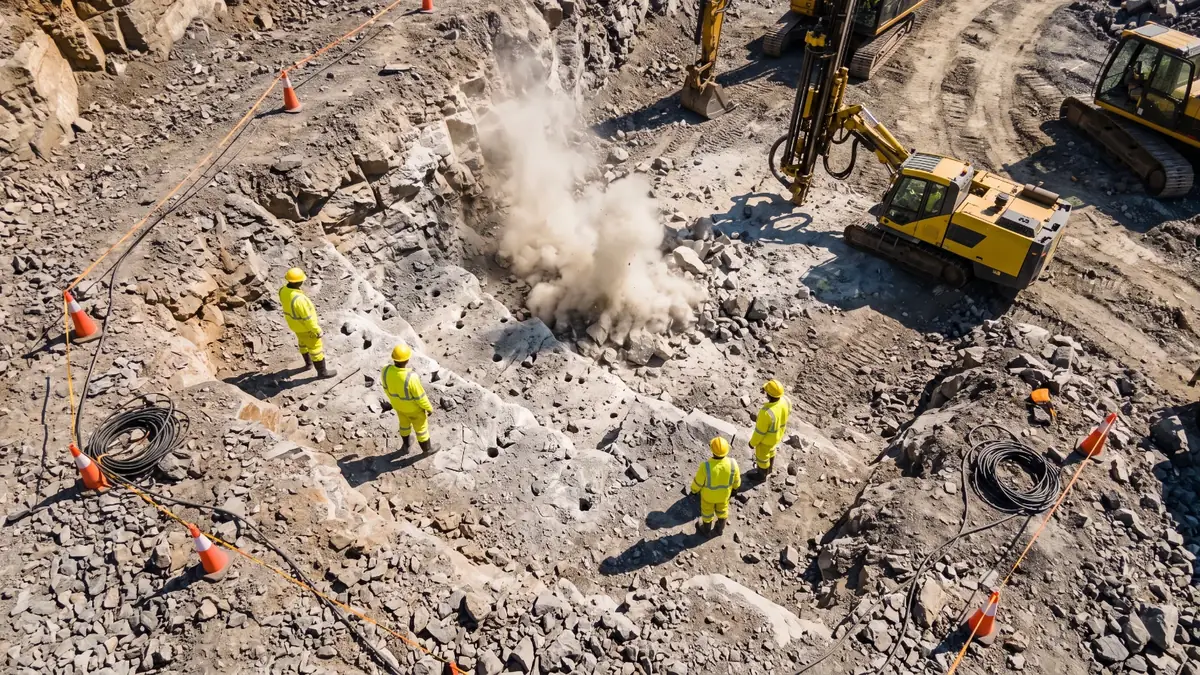
Bulk Blasting South Africa helps you find the best quote, fast. It is rock removal measured in thousands of cubic metres rather than hundreds. The face is worked in benches, the pattern is laid out for production, and the fragmentation is designed so the excavator and the crusher downstream can keep up. Say how many cubic metres have to come out and get quotations to compare.
Super easy & fast
- Know what bulk rock should cost a cubic metre, so you never pay too much.
- Send one set of volumes to several contractors, and quotes come back fast.
- From LEADERR APPROVED providers, vetted and backed by many verified 5-star reviews. Peace of mind that the production rate you are promised is one they have run.
Bulk Blasting Prices
Ballpark figures so you can check a quotation.
| Item | Ballpark price |
|---|---|
| Bulk drill and blast, per cubic metre, over 5,000m3 | R120 - R280 |
| Bulk drill and blast, per cubic metre, 1,000 to 5,000m3 | R180 - R380 |
| Secondary breaking of oversize, per cubic metre | R150 - R450 |
| Mobilisation, production rig and compressor | R25,000 - R90,000 |
| Blast design and bench layout | R15,000 - R60,000 |
| Survey and volume measurement, per blast | R6,000 - R20,000 |
| Load and haul of broken rock, per cubic metre | R90 - R260 |
| Typical 10,000 cubic metre platform, blasted | R1.4m - R3.2m |
Prices JUST UPDATED. Ballpark figures, rounded, excluding VAT. They reflect typical South African rock blasting, breaking and excavation rates. They are not our prices or quotations, and no provider is bound by them. Rock work is quoted on MEASURED VOLUME, and how much rock there is can only be estimated until the face is opened, so confirm what each quotation includes, such as mobilisation, whether the rate is on volume in the ground or loose, and who removes the broken rock.
Say how many cubic metres have to come out and get bulk blasting quotes.
Get the Best QuoteClient Reviews
Powered by leaderr
What Drives a Bulk Rate
- Total volume. The single biggest lever. Rates fall steeply as the quantity rises.
- Bench height. A deeper bench drills more metres per setup and costs less a cubic metre.
- Powder factor. Kilograms of explosive a cubic metre, set by the rock and the fragmentation wanted.
- Drill hole diameter. Bigger holes move more rock per metre drilled, where the site allows them.
- Continuity of work. A rig that stays on site for months is cheaper than one that comes and goes.
Fragmentation Is Part of the Price
- Finer rock costs more to blast. More explosive and tighter spacing, but it loads and hauls faster.
- Coarser rock costs more to handle. Cheaper at the face and slower into the bucket, with oversize to break again.
- Oversize is the hidden cost. Every boulder that will not fit the crusher gets broken a second time.
- The excavator sets the target. Fragmentation is designed around the machine loading it, not in the abstract.
- Measure it rather than argue it. Photographic sizing after a blast settles whether the design is working.
How Bulk Work Is Programmed
- Survey before and after. Volumes are measured, not estimated, and that is what you pay on.
- Benches laid out in advance. Access ramps and face positions are planned before the first hole.
- Blast cycles on a fixed day. A set blasting window lets everyone else on site plan around it.
- Stockpiles planned. Where broken rock stands before it is hauled affects the whole cycle.
- Reconcile monthly. Measured volume against invoiced volume, every month, not at the end.
Get a rate against your own volumes rather than a range.
Get the Best QuoteWhat Affects the Price
- Total volume. The rate per cubic metre falls as the quantity rises, and it falls a long way.
- Bench height and face access. A high clean face is the cheapest rock there is.
- Rock hardness. The powder factor and the drilling both rise with it.
- Required fragmentation. A crusher with a small opening demands finer rock and more explosive.
- Distance from the contractor. Production rigs are heavy and mobilisation is a real number.
- How long the work runs. A twelve month programme prices differently from a three week one.
- Whether load and haul is included. Blasting only and a full earthmoving package are different contracts.
What to Include in Your Request
- The volume. Cubic metres in situ, from a survey if you have one.
- The site layout. Where the rock is, where it has to go and what the levels are.
- What the rock is. Geotechnical information if you have it, otherwise the nearest known outcrop.
- What the rock is for. Spoil, fill or crusher feed each set a different fragmentation.
- The programme. Start date and how long you need it to run.
- Whether you need load and haul. Blasting only, or blasting plus moving it.
Questions That Change the Number
- Is the rate measured in situ or loose? The difference is about half again, and it changes everything.
- Who surveys the volumes? An independent survey settles the monthly measurement before it is disputed.
- What fragmentation is being priced? A cheap rate for coarse rock is expensive at the loader.
- Is secondary breaking included? Oversize is normal and somebody has to pay to break it.
- What is the standing time rate? A rig waiting on your face is billed, so agree the figure upfront.
- Is there a minimum monthly quantity? Production contracts often carry one. Check it suits your programme.
Bulk Blasting FAQs
What does bulk blasting cost a cubic metre?
Over 5,000 cubic metres, roughly R120 to R280 a cubic metre for drill and blast. Between 1,000 and 5,000 it is more like R180 to R380. Below that the mobilisation dominates and the rate per cubic metre stops being the useful number.
Is the rate on in situ or broken volume?
It should be stated plainly, and in situ is the normal basis. Broken rock takes up roughly half as much again, so a rate quoted on loose volume and compared against one quoted in situ will look cheaper when it is not.
What is a powder factor?
The kilograms of explosive used per cubic metre of rock. It is the shorthand for how hard the rock is and how fine the result has to be. A soft rock blasted for spoil might sit near 0.3, hard rock blasted for crusher feed well above that.
How much rock can be blasted in a day?
On an open bench with a production rig, a few thousand cubic metres a blast is routine, with a blast every day or two. Drilling is usually the limit rather than the blasting, so the number of rigs on site is what sets the rate of progress.
What happens to oversize boulders?
They are broken again, either with a hydraulic hammer or by drilling and charging each one. Good fragmentation design keeps the quantity low, but no blast produces none, so ask how secondary breaking is priced before you start.
Do I need my own survey?
It is worth having. Volumes are the basis of payment and a pre and post blast survey by someone independent of the contractor removes the argument. On a large job the cost of the survey is small against the quantity being measured.
Volume is what moves a bulk rate, so sending the same cubic metres to several contractors on Rock Blasting is the quickest way to see what the work is worth.