
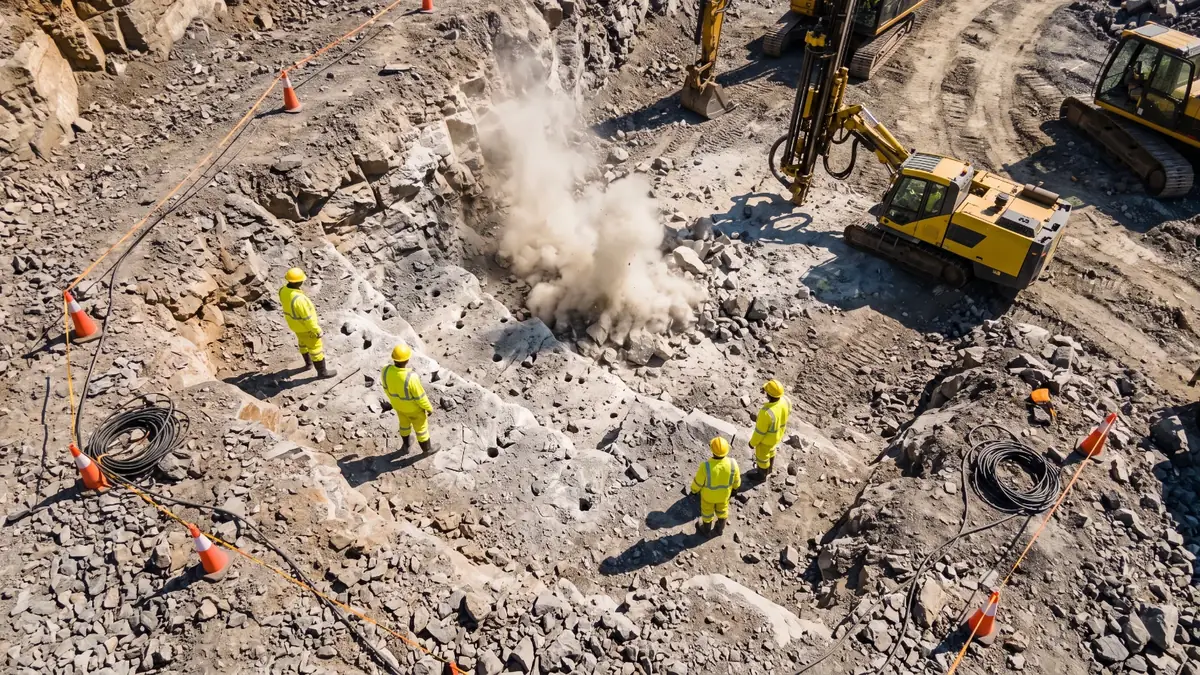
Why is blasting ruled out?
Chemical Rock Breaking South Africa helps you find the best quote, fast. It splits rock and concrete with an expanding grout poured into drilled holes instead of with explosives. There is no detonation, no permit and almost no vibration, so it works where blasting cannot. It is slower and dearer a cubic metre. Say where the rock is and how much there is, and get quotations.
Super easy & fast
- Know what expanding grout should cost a cubic metre, so you never pay too much.
- Send the same job to several contractors, and quotes come back fast.
- From LEADERR APPROVED providers, vetted and backed by many verified 5-star reviews. Peace of mind that a method with no blast still has someone accountable for it.
Chemical Rock Breaking Prices
Ballpark figures so you can check a quotation.
| Item | Ballpark price |
|---|---|
| Chemical rock breaking, per cubic metre | R1,200 - R3,500 |
| Expanding grout, per 5kg of product | R350 - R750 |
| Drilling for grout, per metre | R180 - R420 |
| Breaking mass concrete, per cubic metre | R900 - R2,600 |
| Removal of split rock, per cubic metre | R280 - R650 |
| Minimum site charge | R6,500 - R18,000 |
| Callout and setup, within a metro | R2,500 - R7,500 |
| Typical 20 cubic metre indoor rock cut | R35,000 - R80,000 |
Prices JUST UPDATED. Ballpark figures, rounded, excluding VAT. They reflect typical South African rock blasting, breaking and excavation rates. They are not our prices or quotations, and no provider is bound by them. Rock work is quoted on MEASURED VOLUME, and how much rock there is can only be estimated until the face is opened, so confirm what each quotation includes, such as mobilisation, whether the rate is on volume in the ground or loose, and who removes the broken rock.
Say where the rock is and how much there is, and get chemical rock breaking quotes.
Get the Best QuoteClient Reviews
Powered by leaderr
When Chemical Breaking Is the Right Method
- No blasting permitted. Inside a building, under a structure or where a permit will not be granted.
- Vibration sensitive neighbours. Hospitals, laboratories, heritage structures and anything on old footings.
- Small volumes. Tens of cubic metres, where mobilising a blasting crew makes no sense.
- Confined access. Basements, lift pits and light wells where a rig cannot reach.
- Noise restrictions. The grout works silently, which is often the whole reason it is chosen.
What It Does Not Do Well
- Speed. Holes are drilled, poured and then left. Cracking takes hours, not seconds.
- Large volumes. Above a hundred cubic metres the cost per cubic metre becomes hard to justify.
- Cold or very hot weather. Reaction times shift with temperature and the grade has to match the conditions.
- Very soft or fractured rock. The pressure escapes through existing cracks instead of making new ones.
- Clean separation. It cracks the rock. Something still has to lift it out.
How a Job Runs
- Holes are drilled on a pattern. Spacing is set by the rock and the depth of the cut, usually close together.
- Grout is mixed and poured. Water ratio and grade are matched to the ambient temperature.
- The holes are left to work. Cracks usually open within several hours, sometimes overnight.
- The rock is wedged apart. A breaker, a splitter or a machine opens the cracks and lifts the pieces.
- Repeat as the face advances. The cycle runs again on the newly exposed rock.
Get a price for your own site rather than a range.
Get the Best QuoteWhat Affects the Price
- Volume of rock. Product is consumed per hole, so the cost rises almost in a straight line.
- Rock hardness and jointing. Tight sound rock splits cleanly. Fractured rock wastes product.
- Access. Carrying a drill and water into a basement is slower than working off a slab.
- Ambient temperature. The wrong grade for the weather means a wasted pour and a repeat.
- How fast you need it. Shortening the cycle means more holes at once and more product.
- Whether the rock has to be removed. Splitting and carting away are separate items.
- Minimum charges. On a small job the setup rather than the volume decides the price.
What to Include in Your Request
- The address. Suburb and town, so a contractor knows whether they work there.
- The volume. Length, width and depth of the rock or concrete, even roughly.
- Why blasting is out. Permit, vibration, noise or access. It changes what is quoted.
- Access. Stairs, a lift, a doorway width, and whether water and power are available.
- What is above and below. Occupied floors, services or a structure bearing on the rock.
- Your timing. The method works on its own clock, so a deadline shapes the approach.
Before You Appoint a Contractor
- Is the product grade matched to the season? The commonest reason a pour does nothing.
- How many cycles are allowed for? A quote assuming one pour on rock that needs two is not a quote.
- Who removes the broken rock? Splitting leaves it in place. Getting it out is separate work.
- Is there a minimum charge? On small volumes it is usually the number that matters.
- What happens if the rock does not crack? Ask before, not after. Fractured rock sometimes will not.
- Is a hydraulic splitter being offered as well? Combining the two is often faster and cheaper than either alone.
Chemical Rock Breaking FAQs
How much does chemical rock breaking cost?
Roughly R1,200 to R3,500 a cubic metre, against R180 to R420 for open site blasting. You are paying for a method that needs no permit and makes no vibration, so it is chosen where blasting is impossible rather than where it is merely inconvenient.
How long does expanding grout take to work?
Cracks usually open within several hours and the job is often planned around an overnight cycle. Faster grades exist and they cost more. Temperature changes the timing, which is why the grade has to match the weather on the day.
Does it need a permit?
No. Expanding grout is not an explosive, which is the main reason it is used in buildings, near hospitals and on heritage sites. Normal construction health and safety requirements still apply to the drilling and the removal.
Can it break reinforced concrete?
It cracks the concrete, but the reinforcement holds the pieces together, so it is usually combined with cutting the bars. For mass concrete with little or no steel it works well. For heavily reinforced sections a breaker or a saw is usually better.
Is it quieter than a hydraulic breaker?
Much. The grout itself is silent and the noise is the drilling, which is intermittent rather than continuous. On sites chosen for noise reasons the drilling is often the only thing that needs managing.
What volume is it worth using for?
Up to about a hundred cubic metres it is competitive against the alternatives once permits and vibration are taken into account. Above that the product cost dominates and blasting or mechanical breaking is usually the sensible answer.
Non explosive work is priced very differently from blasting, so contractors on Rock Blasting are worth comparing on method as much as on rate.