
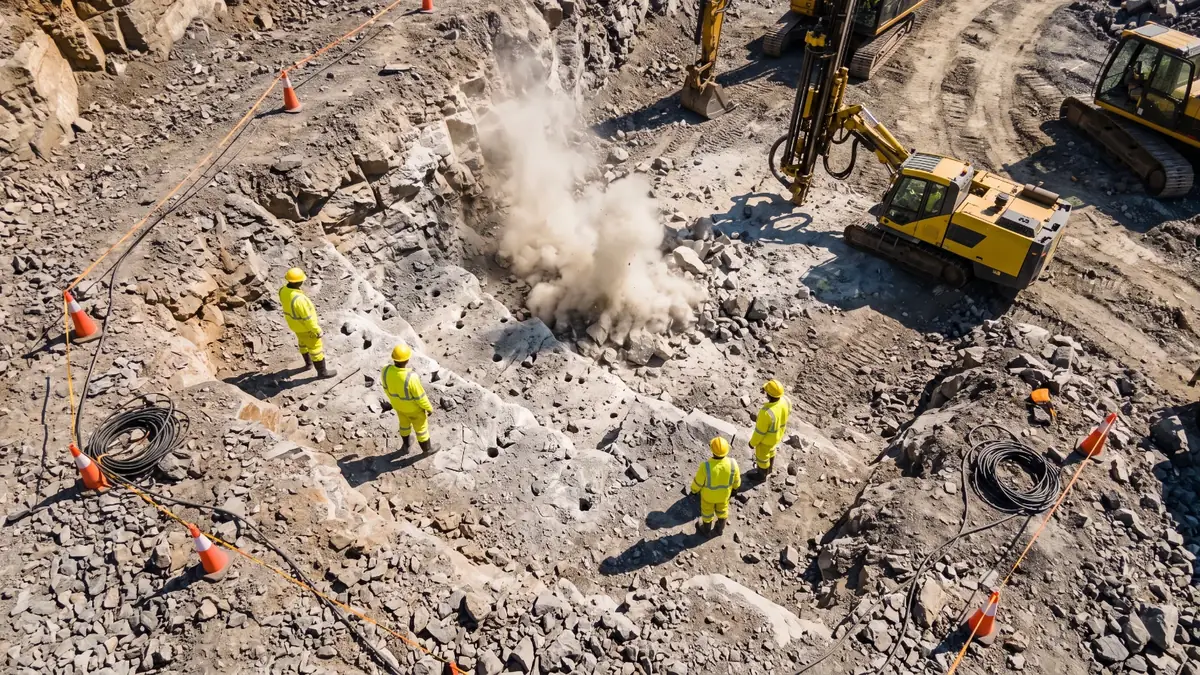
Underwater Blasting South Africa helps you find the best quote, fast. It removes rock below the waterline so a berth, a channel, an intake or a pipeline crossing can reach its design depth. Holes are drilled from a barge or by divers, charged with water resistant product and fired to a marine method statement. Say the water depth and what is being removed, and get quotations.
Super easy & fast
- Know what the dive support and the marine setup should cost, so you never pay too much.
- Send the same survey to several contractors, and quotes come back fast.
- From LEADERR APPROVED providers, vetted and backed by many verified 5-star reviews. Peace of mind that the team holds commercial diving and blasting credentials.
Underwater Blasting Prices
Ballpark figures so you can check a quotation.
| Item | Ballpark price |
|---|---|
| Underwater drill and blast, per cubic metre | R2,500 - R8,000 |
| Dive team, per day, inshore shallow water | R18,000 - R45,000 |
| Jack up barge or drilling platform, per day | R35,000 - R120,000 |
| Pre and post dredge hydrographic survey | R45,000 - R180,000 |
| Mobilisation of marine plant | R120,000 - R600,000 |
| Removal of broken rock by grab, per cubic metre | R450 - R1,400 |
| Fish and marine mammal watch, per blast | R8,000 - R25,000 |
| Typical small berth pocket, 200 cubic metres | R900,000 - R2.4m |
Prices JUST UPDATED. Ballpark figures, rounded, excluding VAT. They reflect typical South African rock blasting, breaking and excavation rates. They are not our prices or quotations, and no provider is bound by them. Rock work is quoted on MEASURED VOLUME, and how much rock there is can only be estimated until the face is opened, so confirm what each quotation includes, such as mobilisation, whether the rate is on volume in the ground or loose, and who removes the broken rock.
Say the water depth and what is being removed, and get underwater blasting quotes.
Get the Best QuoteClient Reviews
Powered by leaderr
Why It Costs What It Does
- The plant is marine. A barge, an anchor spread and a dive spread before a hole is drilled.
- Weather governs the programme. Swell, wind and visibility stop work, and standing time is real.
- Every hole is harder. Drilling through water into a sloping rock head takes positioning most sites never need.
- Charges are bigger. Water confines the blast well, but the product has to be waterproof and well primed.
- Clearance is slow. Broken rock has to be grabbed or dredged out before the next lift is drilled.
The Environmental Side Is Not Optional
- Environmental authorisation. Marine work usually needs it, and the timeline is measured in months.
- Pressure waves travel far in water. Far further than in rock, which is why mitigation is designed in.
- Marine fauna watch. Observers and a clear zone before each firing, with a stand down if anything enters it.
- Bubble curtains. An air curtain around the blast cuts the pressure wave reaching open water.
- Timing restrictions. Breeding and migration seasons can close the window entirely.
How the Work Is Sequenced
- Survey first. A hydrographic survey establishes the rock head and the volume to be removed.
- Position and drill. Holes drilled from a barge, held on position by anchors or spuds.
- Charge and fire in lifts. Rock is taken in layers so the broken material can be cleared between blasts.
- Clear the spoil. A grab or a dredger lifts the broken rock out of the pocket.
- Survey again. The post dredge survey proves the design depth was reached across the whole area.
Get a price for your own site rather than a range.
Get the Best QuoteWhat Affects the Price
- Water depth. Depth sets the dive method, the plant and most of the daily cost.
- Volume of rock. Marine mobilisation is so large that small volumes carry a very high rate.
- Exposure to weather. A sheltered harbour and an open coast are different programmes entirely.
- Distance from a port. Marine plant moves slowly and mobilisation is charged accordingly.
- Environmental conditions. Authorisation, fauna watch and seasonal restrictions all add time.
- What is nearby. Quay walls, pipelines, cables and moored vessels all constrain the charge.
- How the spoil is removed. Grab, airlift or dredger, and where it is permitted to go.
What to Include in Your Request
- The location. Harbour, river, dam or coastline, and the nearest town.
- The water depth. Existing depth and the design depth you need.
- The volume. From a survey if you have one, otherwise the area and the depth to be cut.
- What is nearby. Quay walls, berths, pipelines, cables and any live operations.
- Any environmental authorisation. Whether you hold one, or need help obtaining it.
- Your programme. Marine work books months ahead, so a target date helps.
Before You Appoint a Contractor
- Are the divers commercially qualified? Commercial diving is its own regulated discipline, separate from blasting.
- Who holds the environmental authorisation? And is the time to obtain it inside the programme or outside it?
- How is weather standing time charged? On a marine job this is often the largest variable in the final account.
- Is the post dredge survey included? It is the proof the depth was achieved, so it belongs in the scope.
- What mitigation is proposed for marine life? Observers, clear zones and bubble curtains, stated rather than implied.
- Who clears the broken rock? Blasting and dredging are frequently separate contracts and separate prices.
Underwater Blasting FAQs
What does underwater blasting cost in South Africa?
Roughly R2,500 to R8,000 a cubic metre, which is an order of magnitude above land blasting. The rock is the small part. The barge, the dive spread, the weather days and the environmental requirements carry most of the cost.
Is it dangerous to fish?
Pressure waves travel much further in water than in rock, so marine life is the main environmental concern. The usual mitigation is a marine fauna observer, a clear zone before firing and a bubble curtain around the blast, with a stand down if anything enters the zone.
Does it need environmental authorisation?
Marine blasting normally does, and obtaining it is measured in months rather than weeks. Build it into the programme at the start. A contractor who treats it as an afterthought is telling you something useful.
Can it be done without divers?
Sometimes. Where the water is shallow and the rock head is known, holes can be drilled from a barge with casings and charged from the surface. Divers are usually still needed to inspect, to clear and to confirm the result.
How deep can it be done?
Inshore work in harbours, river mouths and dams is routine. Depth drives the diving method and therefore the cost far more than it drives the blasting, so the practical limit is usually commercial rather than technical.
What happens to the broken rock?
It is lifted out with a grab, an airlift or a dredger, which is frequently a separate contract. Where the material can be disposed of is governed by the environmental authorisation, so it is worth settling before the first blast.
Marine work is quoted on very different assumptions from site to site, so contractors on Rock Blasting are worth comparing line by line rather than on the bottom figure.