
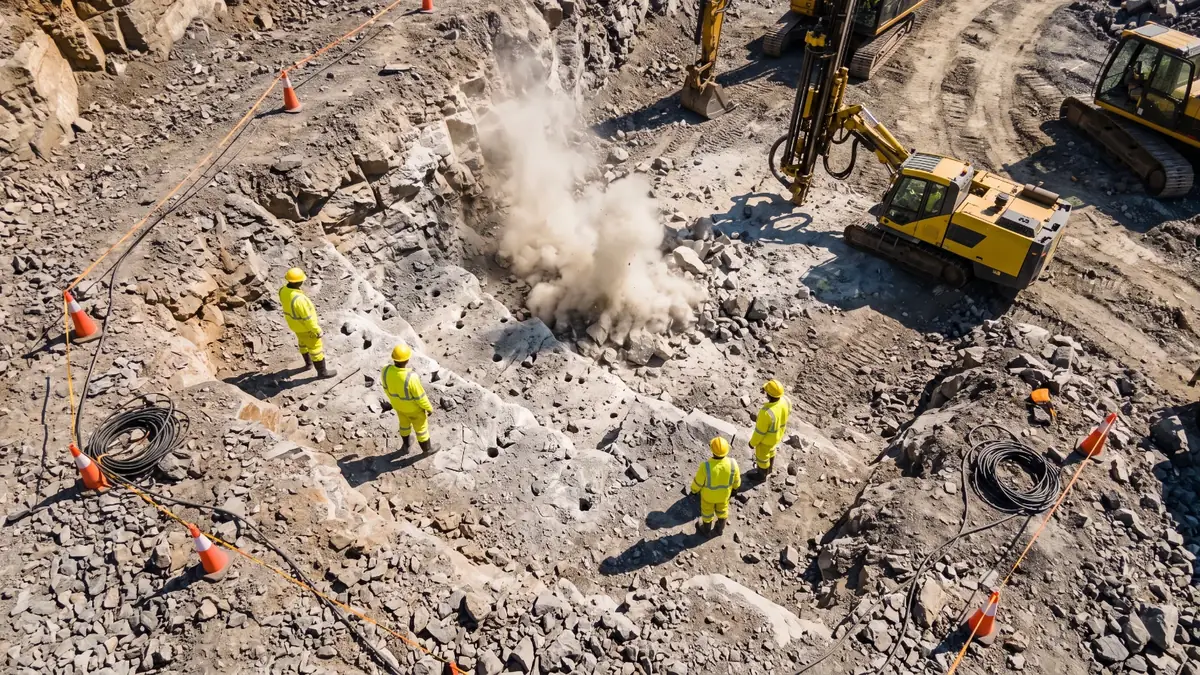
Rock Breaking South Africa helps you find the best quote, fast. It removes rock with a hydraulic hammer on an excavator rather than with explosives. There is no permit and no exclusion zone, so it suits small volumes, confined sites and work that has to run alongside other trades. It is slower in hard rock. Say how much rock there is and get quotations.
Super easy & fast
- Know what an hour of breaking should cost, so you never pay too much.
- Send the same volumes to several contractors, and quotes come back fast.
- From LEADERR APPROVED providers, vetted and backed by many verified 5-star reviews. Peace of mind that the machine arriving is the size the rock needs.
Rock Breaking Prices
Ballpark figures so you can check a quotation.
| Item | Ballpark price |
|---|---|
| Excavator and hammer, per hour, 8 to 14 ton machine | R850 - R1,600 |
| Excavator and hammer, per hour, 20 to 30 ton machine | R1,400 - R2,800 |
| Rock breaking, per cubic metre, weathered rock | R250 - R600 |
| Rock breaking, per cubic metre, hard rock | R600 - R1,400 |
| Mini excavator and hammer, per day, confined site | R4,500 - R9,500 |
| Lowbed delivery and collection of machine | R3,500 - R12,000 |
| Operator standing time, per hour | R450 - R900 |
| Typical 50 cubic metre hard rock cut | R35,000 - R75,000 |
Prices JUST UPDATED. Ballpark figures, rounded, excluding VAT. They reflect typical South African rock blasting, breaking and excavation rates. They are not our prices or quotations, and no provider is bound by them. Rock work is quoted on MEASURED VOLUME, and how much rock there is can only be estimated until the face is opened, so confirm what each quotation includes, such as mobilisation, whether the rate is on volume in the ground or loose, and who removes the broken rock.
Say how much rock there is and how hard it is, and get rock breaking quotes.
Get the Best QuoteClient Reviews
Powered by leaderr
How Rock Breaking Is Priced
- By the hour. The common basis. Simple to agree and it puts the production risk on you.
- By the cubic metre. Better for you where the volume is known, because the contractor carries the risk.
- By the day. Usual for small machines on confined sites, with a stated number of hours.
- Plus transport. Lowbed in and out is a separate charge whatever the rate basis.
- Plus consumables on long jobs. Chisel wear in abrasive rock is sometimes carried separately.
Machine Size Decides Everything
- A small hammer in hard rock stalls. It bounces rather than breaks, and the hours mount with nothing to show.
- An oversized machine cannot get in. A 30 ton excavator needs room to track, swing and be delivered.
- Match the hammer to the rock. Impact energy, not machine weight, is what breaks hard rock.
- Reach matters in a trench or pit. Breaking at depth needs a longer boom or a smaller machine down in it.
- Two small machines beat one stuck big one. On a confined site, access usually wins the argument.
When Breaking Beats Blasting
- Small volumes. Below roughly a hundred cubic metres, setup and permits make blasting awkward.
- No exclusion zone available. A live site with other trades working cannot be cleared for a blast.
- Trimming to line and level. A hammer takes rock back to a face accurately. A blast does not.
- Secondary breaking. Oversize boulders after a blast are broken this way.
- Irregular shapes. Pockets, benches and odd corners suit a machine better than a drill pattern.
Get a price for your own site rather than a range.
Get the Best QuoteWhat Affects the Price
- Rock hardness. The single biggest factor. Hard rock can halve the cubic metres an hour.
- Machine size available on site. Access limits the machine, and the machine limits the output.
- Volume. Larger volumes get better rates, and above a point blasting becomes cheaper still.
- Depth of the work. Breaking in a trench or a pit is slower than breaking off a level platform.
- Whether the rock has to be removed. Breaking leaves it in place. Loading and hauling is priced separately.
- Transport distance. The lowbed charge is fixed and matters most on a short job.
- Working hours. Noise restrictions in a residential area limit the day.
What to Include in Your Request
- The address. Suburb and town, so a contractor knows whether they work there.
- The volume. Length, width and depth of the rock, even approximately.
- What the rock is. Granite, dolerite, sandstone or weathered material each break differently.
- Access. Gate width, ground conditions and whether a lowbed can get in.
- Whether you want it removed. Breaking only, or breaking plus load and cart away.
- Any noise restriction. Residential hours, a body corporate rule or a council condition.
Questions That Change the Number
- Hourly or per cubic metre? Per cubic metre moves the production risk off you, where the volume is known.
- What size machine is being sent? A rate without a machine size attached cannot be compared.
- Is the lowbed in or out of the rate? On a two day job it can be a quarter of the cost.
- Who pays for standing time? Agree the rate before the machine is waiting on something you control.
- Is there a minimum number of hours? Half day and full day minimums are normal. Know which applies.
- Would blasting be cheaper here? On a large volume a good contractor will tell you so.
Rock Breaking FAQs
How much does rock breaking cost per hour in South Africa?
Roughly R850 to R1,600 an hour for an 8 to 14 ton excavator and hammer, and R1,400 to R2,800 for a 20 to 30 ton machine. Transport to and from site is charged separately and is often the deciding cost on a short job.
Is it cheaper to break rock or blast it?
Below about a hundred cubic metres, breaking usually wins because blasting carries mobilisation, permits and a pre-blast survey. Above a few hundred cubic metres of hard rock, blasting is normally much cheaper and considerably faster.
How much rock can a hammer break in a day?
In weathered rock a 20 ton machine might take out 60 to 100 cubic metres in a day. In hard unweathered dolerite the same machine might manage 15 to 30. That spread is why an hourly rate on hard rock can surprise people.
Does rock breaking cause vibration?
It causes less than a blast but it carries on all day rather than for a moment, which neighbours often find harder to live with. On sensitive sites a seismograph is worth placing for breaking just as it is for blasting.
Do I need a permit to break rock?
No. There are no explosives involved, so no permit is required. Normal construction health and safety obligations apply, and noise restrictions in a residential area may limit your working hours.
Can a hammer work in a basement?
Yes, with a small machine. Access, headroom, ventilation and getting the broken rock out are the practical limits rather than the breaking itself. Mini excavators with hammers are made for exactly that work.
Hourly rates look similar until you attach a machine size, which is why contractors on Rock Blasting are worth comparing on output rather than on the rate alone.