
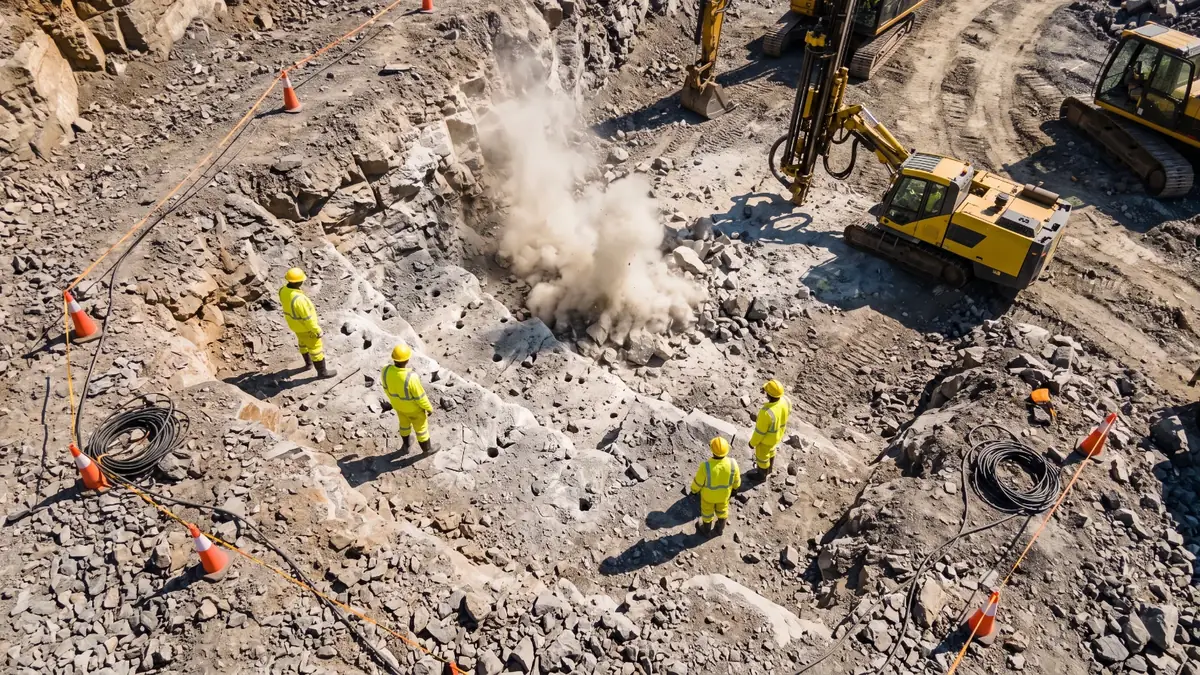
Trench Blasting South Africa helps you find the best quote, fast. It breaks a narrow line of rock so a pipe, a cable or a sewer can be laid at depth. It is drilled in a tight pattern down the route and fired in short lengths, so the trench walls stand and the service bed stays level. Say how long the trench is and how deep it has to go, and get priced quotations.
Super easy & fast
- Know what a metre of rock trench should cost, so you never pay too much.
- Send the route and the depth to several contractors, and quotes come back fast.
- From LEADERR APPROVED providers, vetted and backed by many verified 5-star reviews. Peace of mind that the services already in the ground are found first.
Trench Blasting Prices
Ballpark figures so you can check a quotation.
| Item | Ballpark price |
|---|---|
| Trench blasting, per linear metre, 600mm wide by 1m deep | R450 - R1,200 |
| Trench blasting, per linear metre, 900mm wide by 1.5m deep | R900 - R2,400 |
| Trench blasting, per cubic metre of rock | R350 - R900 |
| Service location and hand excavation of trial holes | R450 - R1,400 |
| Mobilisation, within a metro | R8,000 - R25,000 |
| Vibration monitoring, per seismograph per day | R4,500 - R15,000 |
| Cart away of broken rock, per cubic metre | R180 - R420 |
| Typical 100 metre services trench in rock | R65,000 - R180,000 |
Prices JUST UPDATED. Ballpark figures, rounded, excluding VAT. They reflect typical South African rock blasting, breaking and excavation rates. They are not our prices or quotations, and no provider is bound by them. Rock work is quoted on MEASURED VOLUME, and how much rock there is can only be estimated until the face is opened, so confirm what each quotation includes, such as mobilisation, whether the rate is on volume in the ground or loose, and who removes the broken rock.
Say how long the trench is and how deep it has to go, and get trench blasting quotes.
Get the Best QuoteClient Reviews
Powered by leaderr
What a Trench Blasting Quote Covers
- Setting out the route. The line and the levels, so the holes are drilled where the pipe will run.
- Service location. Finding what is already buried before a hole goes down. Non negotiable on a street.
- Drilling the pattern. Close spaced holes along the trench, usually in two rows for a wide one.
- Charging and firing in lengths. Short sections at a time, so the trench can be cleaned and advanced.
- Cleaning out to level. An excavator lifts the broken rock and trims the bed.
Where Quotes Differ Most
- Trench width and depth. The cubic metres follow directly, and so does the rate per metre run.
- Whether cart away is included. Broken rock off a trench is bulky and the haul is a real cost.
- What is in the street. A route with water, sewer, fibre and power in it is slow and careful work.
- Traffic accommodation. Lane closures, signage and a traffic plan on a public road.
- Reinstatement. Bedding, backfill and surfacing are often a separate contractor and a separate price.
How a Rock Trench Is Taken Out
- Trial holes first. Hand dug where services are expected, because a drill through a cable is the worst outcome.
- Drilled in lifts. A deep trench is taken in two passes rather than one, which keeps the walls sound.
- Light charges, close spacing. A trench wants the rock cracked and lifted, not thrown down the street.
- Covered where it has to be. Mats over the line of holes on any trench near traffic or buildings.
- Cleaned and checked to level. The bed is trimmed so the pipe sits on bedding, not on a point of rock.
Get a price for your own route rather than a range.
Get the Best QuoteWhat Affects the Price
- Length of the trench. Rates improve with length because the setup is spread further.
- Depth and width. Together they set the cubic metres, which is what the rock price is built on.
- Rock hardness. Harder rock means closer holes and more explosive a metre run.
- Existing services. A congested street route can cost more than twice an open servitude.
- Access along the route. A rig that has to work off a narrow verge moves slowly.
- Whether the spoil is removed. Carting broken rock away is priced by volume and by haul distance.
- Traffic and working hours. Night work or a restricted window stretches the programme.
What to Include in Your Request
- The route. Start, end and roughly what it crosses. A sketch or a pin helps.
- Trench width and depth. The size the service needs, not the size of the rock.
- What the trench is for. Water, sewer, power, fibre or a pipeline each have their own bedding.
- Known services. Any as built drawings you have, or where the marker tape is.
- Whether it is a public road. It changes the permissions and the traffic accommodation.
- Whether you want the rock removed. Blasting only, or blasting plus cart away and backfill.
Before You Appoint a Contractor
- Is service location included? In writing, before drilling starts. This is where the expensive mistakes live.
- Is the rate per metre run or per cubic metre? They convert, but only if you know the trench size being assumed.
- What happens where there is no rock? A route that turns to soil halfway should be re-measured, not billed as rock.
- Is cart away in or out? Rock from a trench bulks up by about half again once broken.
- Who does the reinstatement? Backfill, compaction and surfacing may sit with another contractor.
- Is a traffic plan needed and who prepares it? On a public road it is usually a council requirement.
Trench Blasting FAQs
How much does trench blasting cost per metre?
For a 600mm wide trench a metre deep in rock, roughly R450 to R1,200 a linear metre plus mobilisation. A 900mm trench at 1.5 metres deep runs R900 to R2,400. The cubic metres are what drive it, so the width and depth matter more than the length.
Can a trench be blasted in a suburban street?
Yes, and most rock services trenches are. The charges are small, the holes are close together and the line is covered with mats. Service location and a pre-blast survey of the houses on either side are the two things that make it go smoothly.
What happens if you hit a cable?
The way to answer that is to make it not happen. Trial holes are hand dug where services are expected and a locator is run down the route before any drilling. A contractor who will not price service location separately is worth passing over.
Is blasting better than a rock breaker for a trench?
Over any real length, usually. A breaker working a narrow trench in hard rock is slow and it shakes the ground continuously rather than briefly. Over a few metres the breaker wins because there is no setup.
How much does the rock bulk up?
Broken rock takes up roughly half as much again as it did in the ground, so a trench that yields 40 cubic metres in situ produces around 60 cubic metres to move. That matters when the cart away is priced by the load.
Does the trench need shoring afterwards?
In sound rock the walls usually stand without support, which is one of the reasons a rock trench is attractive. Where the rock is fractured or the trench is deep, the engineer may still call for support, and that is a separate item.
A rock trench is one of the jobs where quotations vary most, which is why contractors on Rock Blasting are worth comparing on the measured rate rather than the total.