
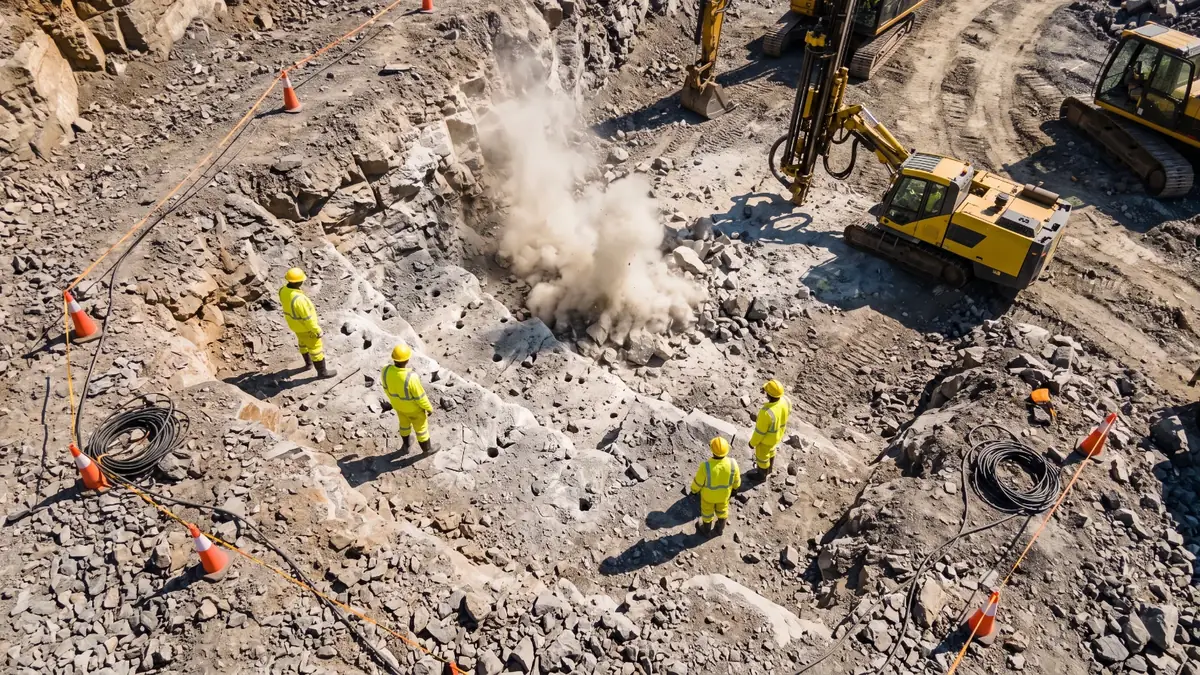
What is closest to the rock?
Controlled Blasting South Africa helps you find the best quote, fast. It is blasting designed around what stands next to it. The charge fired on each delay is cut, the pattern is tightened and the blast is covered, so the ground movement stays inside an agreed limit. Say what stands nearest the rock and get quotations you can line up.
Super easy & fast
- Know what the lower charge and the extra blasts should cost, so you never pay too much.
- Send the same constraints to several contractors, and quotes come back fast.
- From LEADERR APPROVED providers, vetted and backed by many verified 5-star reviews. Peace of mind that the vibration limit is measured, not assumed.
Controlled Blasting Prices
Ballpark figures so you can check a quotation.
| Item | Ballpark price |
|---|---|
| Controlled blasting, per cubic metre, near structures | R450 - R1,100 |
| Controlled blasting, per cubic metre, tight urban site | R900 - R2,200 |
| Blasting mats, per blast covered | R6,000 - R18,000 |
| Pre-blast condition survey, per structure | R350 - R900 |
| Vibration monitoring, per seismograph per day | R4,500 - R15,000 |
| Blast design to a stated vibration limit | R12,000 - R45,000 |
| Mobilisation, within a metro | R8,000 - R25,000 |
| Typical 200 cubic metre urban cut | R120,000 - R350,000 |
Prices JUST UPDATED. Ballpark figures, rounded, excluding VAT. They reflect typical South African rock blasting, breaking and excavation rates. They are not our prices or quotations, and no provider is bound by them. Rock work is quoted on MEASURED VOLUME, and how much rock there is can only be estimated until the face is opened, so confirm what each quotation includes, such as mobilisation, whether the rate is on volume in the ground or loose, and who removes the broken rock.
Say what stands nearest the rock and get controlled blasting quotes.
Get the Best QuoteClient Reviews
Powered by leaderr
What Makes a Blast Controlled
- Charge mass per delay. The single figure that decides ground vibration. Cutting it is the whole method.
- More delays, smaller holes. The same volume is broken in many small events instead of one big one.
- Tighter drill pattern. Closer spacing and less burden, so less explosive does the same work.
- Covering the blast. Mats and stemming keep the rock on the ground where it fell.
- A measured result. A seismograph on the nearest structure records every blast rather than estimating it.
Where Quotes Differ Most
- The limit being designed to. A tight limit means more blasts for the same volume, and the rate follows.
- How many structures need surveying. Each one is photographed and recorded before work starts.
- Who supplies the seismograph. Hired by the contractor or appointed by you are different totals.
- Whether mats are in the rate. Covering is slow and is often a separate line.
- Working hours. A site restricted to one blast window a day takes longer than one that is not.
How the Limit Is Set and Kept
- The engineer sets it. The project engineer or the client specification names the limit for your site.
- It is given as peak particle velocity. Measured in millimetres a second at the nearest structure, not at the blast.
- A trial blast calibrates the design. A small first blast gives the real site response rather than a textbook one.
- Each blast is recorded. The seismograph trace is kept and issued, which is your evidence afterwards.
- The design is adjusted. If a reading runs high the charge comes down on the next blast.
Get a price against your own vibration limit rather than a range.
Get the Best QuoteWhat Affects the Price
- Distance to the nearest structure. The closer it is, the smaller every charge has to be.
- What the structure is. An old plastered cottage and a new concrete frame are not held to the same figure.
- The limit in the specification. A tight limit can double the number of blasts for the same volume.
- Rock hardness. Harder rock resists a cut charge and needs more holes to break the same volume.
- Buried services. Water, sewer, fibre and gas lines near the face change the pattern and the method.
- How many blasts a day are allowed. A single permitted window stretches the programme and the standing time.
- Monitoring requirements. Several seismographs on several structures multiply the daily charge.
What to Include in Your Request
- The address. Suburb and town, so a contractor knows whether they work there.
- The distance to the nearest building. In metres, and what that building is built of.
- Any limit you have been given. If an engineer has named a figure, send it with the enquiry.
- The volume of rock. Length, width and depth of the cut, even approximately.
- Known services. Anything buried or overhead within the working area.
- Your working hours. Any restriction on when a blast may be fired.
Questions That Change the Number
- What limit are you designing to? If nobody can name a figure, nobody is controlling anything.
- Is monitoring on every blast or spot checks? Every blast is what makes the record worth having.
- Is a trial blast included? It calibrates the design to your rock rather than to an assumption.
- Who issues the seismograph reports, and how fast? A report a week later is no use in a dispute.
- Is the pre-blast survey independent? A survey by the blaster is worth less than one by a third party.
- What happens if a reading exceeds the limit? The answer should be a stated change to the design, in writing.
Controlled Blasting FAQs
What does controlled blasting cost against ordinary blasting?
Usually two to three times a cubic metre. The volume does not change but the number of blasts does, because each one carries a much smaller charge. On a tight urban site R900 to R2,200 a cubic metre is common against R180 to R420 on an open one.
What is peak particle velocity?
The fastest the ground moves as the blast wave passes, measured in millimetres a second by a seismograph placed at the structure being protected rather than at the blast. It is the figure every vibration specification is written in.
Who decides the vibration limit for my site?
The project engineer, or the client specification the contract is written against. There is no single national figure, and it depends on what the nearby structure is and its condition. Some municipalities attach conditions of their own, so check with yours.
Can you blast against a boundary wall?
Yes, and it is routine work. The charge per delay comes right down, the face is covered, and a seismograph goes on the wall. A pre-blast survey of that wall is the thing most worth insisting on, because a wall on a boundary is where disputes start.
Is controlled blasting quieter?
The ground vibration is far lower, which is what protects structures. Airblast, the pressure wave people hear, is reduced by good stemming and by covering the blast, but a blast is never silent and neighbours should be told when it will happen.
Could I avoid blasting altogether?
On small volumes beside sensitive structures, chemical rock breaking or hydraulic splitting removes the vibration question entirely. They cost more a cubic metre and work much more slowly, so they suit tens of cubic metres rather than hundreds.
Vibration is the question every neighbour asks, and comparing how contractors on Rock Blasting answer it tells you more than the rate does.