
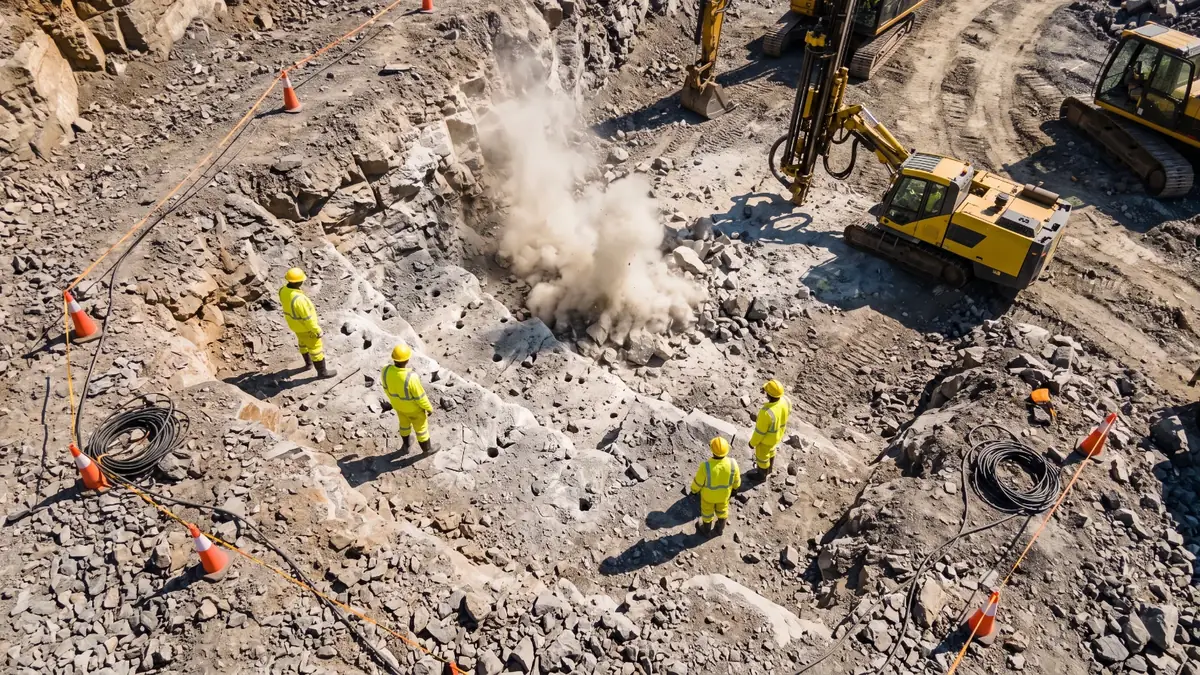
Will traffic stay open?
Roadworks Blasting South Africa helps you find the best quote, fast. It takes rock out of a road cutting, a widening or a new alignment, usually while traffic is still running past it. The blasting is ordinary; the constraints are not, because the road has to reopen and the final face has to stand without maintenance. Say the cutting length and depth, and get quotations.
Super easy & fast
- Know what a cubic metre in a road cutting should cost, so you never pay too much.
- Send the same alignment to several contractors, and quotes come back fast.
- From LEADERR APPROVED providers, vetted and backed by many verified 5-star reviews. Peace of mind that traffic accommodation is planned rather than improvised.
Roadworks Blasting Prices
Ballpark figures so you can check a quotation.
| Item | Ballpark price |
|---|---|
| Drill and blast in a road cutting, per cubic metre | R220 - R550 |
| Pre splitting the final face, per square metre | R180 - R480 |
| Blasting under live traffic, per cubic metre | R450 - R1,100 |
| Traffic accommodation, per day | R6,500 - R28,000 |
| Blasting mats, per blast covered | R6,000 - R18,000 |
| Clearing the road after a blast, per event | R8,000 - R35,000 |
| Rock face scaling and mesh, per square metre | R280 - R850 |
| Typical 2,000 cubic metre cutting | R480,000 - R1.2m |
Prices JUST UPDATED. Ballpark figures, rounded, excluding VAT. They reflect typical South African rock blasting, breaking and excavation rates. They are not our prices or quotations, and no provider is bound by them. Rock work is quoted on MEASURED VOLUME, and how much rock there is can only be estimated until the face is opened, so confirm what each quotation includes, such as mobilisation, whether the rate is on volume in the ground or loose, and who removes the broken rock.
Say the cutting length and depth, and get roadworks blasting quotes.
Get the Best QuoteClient Reviews
Powered by leaderr
What Makes Road Blasting Different
- The road has to reopen. Every blast is planned around a closure window and a clearing time.
- Traffic accommodation. Signage, stop and go, a traffic plan and approval from the road authority.
- Flyrock onto a carriageway. The risk that governs everything. Mats, stemming and a cleared zone.
- The final face stays. Unlike a platform cut, the face is permanent and has to be stable.
- Services in the reserve. Roads carry cables, pipes and fibre along and across them.
Controlling the Final Face
- Pre splitting. A row of lightly charged holes along the design line, fired first, leaving a clean face.
- Smooth blasting. A final row fired last, with reduced charges, to trim back to the line.
- Why it is worth paying for. An over broken face sheds rock onto the road for years afterwards.
- Scaling after every blast. Loose material comes down deliberately rather than onto a vehicle.
- Mesh and bolting where needed. A separate specialist discipline, often priced by others.
Working Around Traffic
- Fixed blasting times. Published and consistent, so road users and the authority can plan.
- Short closures. Measured in minutes, with the clearing crew ready before the blast is fired.
- Guards on every approach. Including the farm track nobody mentioned at the start.
- Clear the carriageway fast. A loader standing by is part of the method, not an afterthought.
- Inspect before reopening. The road is checked for rock and damage before traffic returns.
Get a price for your own alignment rather than a range.
Get the Best QuoteWhat Affects the Price
- Volume of rock. The base figure every rate works from.
- Whether traffic is live. Blasting beside a running road can double the rate per cubic metre.
- Final face treatment. Pre splitting and smooth blasting are extra and usually specified.
- Cutting depth and length. Deep cuttings mean more lifts and more face to control.
- The road authority's conditions. Closure windows and approvals shape the programme.
- Services in the road reserve. Locating and protecting them adds time before any drilling.
- Distance from the contractor. Rural alignments carry a real mobilisation.
What to Include in Your Request
- The road and the chainage. Which road, and roughly where along it.
- Cutting dimensions. Length, depth and the design side slopes.
- Whether traffic stays open. Full closure, half width or a deviation.
- Which authority owns the road. National, provincial or municipal, because conditions differ.
- Known services. Anything in or crossing the road reserve.
- Final face requirements. Whether pre splitting or smooth blasting is specified.
Before You Appoint a Contractor
- Who obtains the road authority approval? And is the time to get it inside the programme?
- Is traffic accommodation in the rate? It is a significant daily cost and it is often excluded.
- Is pre splitting included? If the specification calls for it, make sure it is priced.
- How long is each closure? A contractor who cannot answer in minutes has not planned it.
- Who clears the road after a blast? It has to be immediate, so the plant must already be there.
- What is the flyrock control method? Mats, stemming depth and the cleared zone, stated specifically.
Roadworks Blasting FAQs
How much does blasting in a road cutting cost?
Roughly R220 to R550 a cubic metre where the road is closed and there is room to work, and R450 to R1,100 where traffic is running past and every blast is a short closure. Traffic accommodation is usually a separate daily charge.
How long does a road close for a blast?
Typically a short window measured in minutes rather than hours, with guards placed beforehand and a loader standing by to clear the carriageway immediately. The clearing, not the blasting, is what sets how long the road stays shut.
What is pre splitting?
A row of closely spaced, lightly charged holes drilled along the design face line and fired before the main blast. It creates a crack along that line so the main blast breaks back to it cleanly, leaving a sound final face rather than a shattered one.
Why does the final face matter so much?
Because unlike a construction cut it is permanent, and a face that was over broken sheds rock onto the road for years. Paying for pre splitting or smooth blasting once is far cheaper than scaling, meshing and clearing the same cutting repeatedly.
Who approves blasting next to a public road?
The road authority that owns it, which may be national, provincial or municipal, and their conditions differ. Explosives themselves are permitted separately under the Explosives Act 15 of 2003, and the two approvals run on different timelines.
What stops rock landing on the road?
Blasting mats over the charged area, adequate stemming in every hole, a reduced charge per delay and a cleared zone with guards on every approach. A contractor should describe those specifically rather than offering a general assurance.
Traffic accommodation and face treatment are where road quotes diverge, so comparing contractors on Rock Blasting line by line matters more here than usual.