
How much rock is there?
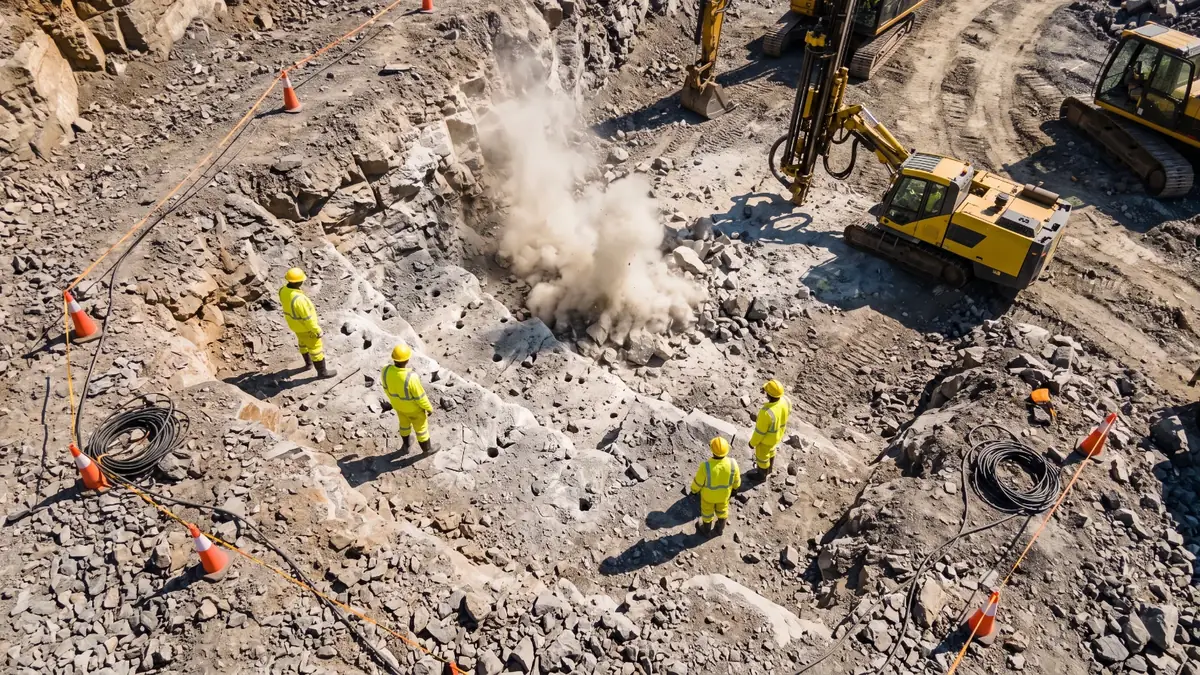
Rock Blasting South Africa helps you find the best quote, fast. It is the controlled use of explosives to break rock that a machine cannot dig. The hole pattern is drilled, charged and fired in millisecond delays so the rock fractures and drops where it is wanted instead of being thrown. Say how much rock has to come out and what stands near it, and get priced quotations to compare.
Super easy & fast
- Know what a cubic metre of broken rock should cost, so you never pay too much.
- Send the same site details to several blasting contractors, and quotes come back fast.
- From LEADERR APPROVED providers, vetted and backed by many verified 5-star reviews. Peace of mind that the crew on your site is certificated and insured.
Rock Blasting Prices
Ballpark figures so you can check a quotation.
| Item | Ballpark price |
|---|---|
| Drill and blast, per cubic metre, open site | R180 - R420 |
| Drill and blast, per cubic metre, built-up area | R450 - R1,100 |
| Mobilisation, within a metro | R8,000 - R25,000 |
| Mobilisation, rural or long haul | R25,000 - R75,000 |
| Blast design and drill pattern layout | R8,000 - R35,000 |
| Pre-blast condition survey, per structure | R350 - R900 |
| Vibration monitoring, per seismograph per day | R4,500 - R15,000 |
| Typical 500 cubic metre site, drilled and blasted | R140,000 - R320,000 |
Prices JUST UPDATED. Ballpark figures, rounded, excluding VAT. They reflect typical South African rock blasting, breaking and excavation rates. They are not our prices or quotations, and no provider is bound by them. Rock work is quoted on MEASURED VOLUME, and how much rock there is can only be estimated until the face is opened, so confirm what each quotation includes, such as mobilisation, whether the rate is on volume in the ground or loose, and who removes the broken rock.
Say how much rock has to come out and what stands near it, and get blasting quotes.
Get the Best QuoteClient Reviews
Powered by leaderr
What a Blasting Quote Covers
- Mobilisation. Getting the rig, compressor and magazine vehicle onto the property. Charged on distance.
- Drilling. The hole pattern, priced per metre drilled or rolled into the rate per cubic metre.
- Explosives and accessories. Emulsion or cartridge product, detonators and delays, drawn against a permit.
- Blasting mats or stemming. What stops flyrock. The item that separates an open site from a built-up one.
- The certificated blaster. A blast is fired by a person holding a current certificate, not by the machine operator.
Where Quotes Differ Most
- Rock hardness. Dolerite and quartzite take more drilling and more explosive than weathered shale.
- How close the neighbours are. Proximity sets the charge mass per delay, and that sets how many blasts it takes.
- Whether mats are in the rate. Covering a blast is slow work and is often quoted separately.
- Who does the monitoring. Some quotes carry a seismograph, some expect you to appoint one.
- Whether the broken rock is removed. Blasting and carting away are two different jobs and two different prices.
How the Work Runs on Site
- The survey comes first. Neighbouring structures are photographed and recorded before anything is fired.
- Holes are drilled to the design. Depth, spacing and burden are set by the design, not by eye.
- Charging and stemming. Each hole is loaded and topped with stemming so the energy goes into the rock.
- The area is cleared and guarded. Sirens, guards on the approaches and a stated exclusion zone.
- The blast is fired and the face made safe. Loose rock is scaled down before anyone works under it.
Get a price for your own site rather than a range.
Get the Best QuoteWhat Affects the Price
- How much rock there is. Volume in cubic metres is the figure every rate is built on.
- What stands nearby. Houses, services and retaining walls cut the charge per delay and add blasts.
- Rock hardness. Harder rock means tighter spacing, more holes and more explosive a cubic metre.
- Access for the rig. A track-mounted rig that cannot reach the face changes the method entirely.
- Distance from the contractor. Mobilisation on a rural job can exceed the blasting on a small volume.
- Whether monitoring is required. A specification calling for seismographs adds a daily charge.
- How busy the crews are. Rates firm up when the civil contractors in a province are all on programme.
What to Include in Your Request
- The address. Suburb and town, so a contractor knows whether they work there.
- The volume. Length, width and depth of the rock to be removed, even roughly.
- What is nearest. Distance to the closest house, wall, pipeline or power line.
- Access. Gate width, ground conditions and how close a truck can get to the face.
- Whether you want the rock removed. Blasting only, or blasting plus cart away.
- Your timing. A permit and a pre-blast survey take time before a rig can book.
Before You Appoint a Blasting Contractor
- Ask to see the blasting certificate. The person firing the blast holds it personally, and it has an expiry date.
- Ask about the explosives permit. Acquiring, moving and storing explosives is permitted work under the Explosives Act.
- Ask what the public liability cover is. And whether it names blasting rather than general construction.
- Ask whether a pre-blast survey is included. Without one you cannot answer a cracked wall claim either way.
- Ask how flyrock is controlled. Mats, stemming depth and the exclusion zone are the answer, not reassurance.
- Ask what happens to the broken rock. Left on site, stockpiled or carted away are three different totals.
Rock Blasting FAQs
How much does rock blasting cost in South Africa?
For an open site with room to work, roughly R180 to R420 a cubic metre of in situ rock, plus mobilisation. In a built-up area where the charge has to be cut and the blast covered, R450 to R1,100 a cubic metre is more usual. The volume and the neighbours move it more than anything else.
Is blasting cheaper than breaking the rock with a machine?
Above a few hundred cubic metres, usually yes. A hydraulic breaker is priced by the hour and hard rock slows it right down, while a blast prices by volume. Below that the mobilisation and the permit work make blasting hard to justify and a breaker or a splitter wins.
Can you blast near houses?
It is done regularly. The charge mass fired per delay is reduced, the blast is covered, and a seismograph records what the nearest structure felt. The limit for your site is set by the project engineer or the client specification rather than by one national figure, and some municipalities attach their own conditions, so check with yours.
Who is allowed to fire a blast?
A person holding a current blasting certificate of competency. Explosives are acquired, transported, stored and used under the Explosives Act 15 of 2003 and the permits that go with it. On a mine or a quarry the Mine Health and Safety Act applies as well.
Will blasting damage my neighbour's house?
A properly designed blast is kept well below the level at which cosmetic damage starts. The protection for everybody is the pre-blast condition survey, which records existing cracks with photographs and dates before a hole is drilled, and the seismograph record for each blast.
How long does it take?
The permit work and the condition survey usually take longer than the blasting. Once a rig is on site, a few hundred cubic metres is commonly drilled and fired within a week, with one blast a day where the volume needs more than one.
Rock removal is the service nearly every contractor on Rock Blasting is asked for first, and the one most worth lining up quotations on.