
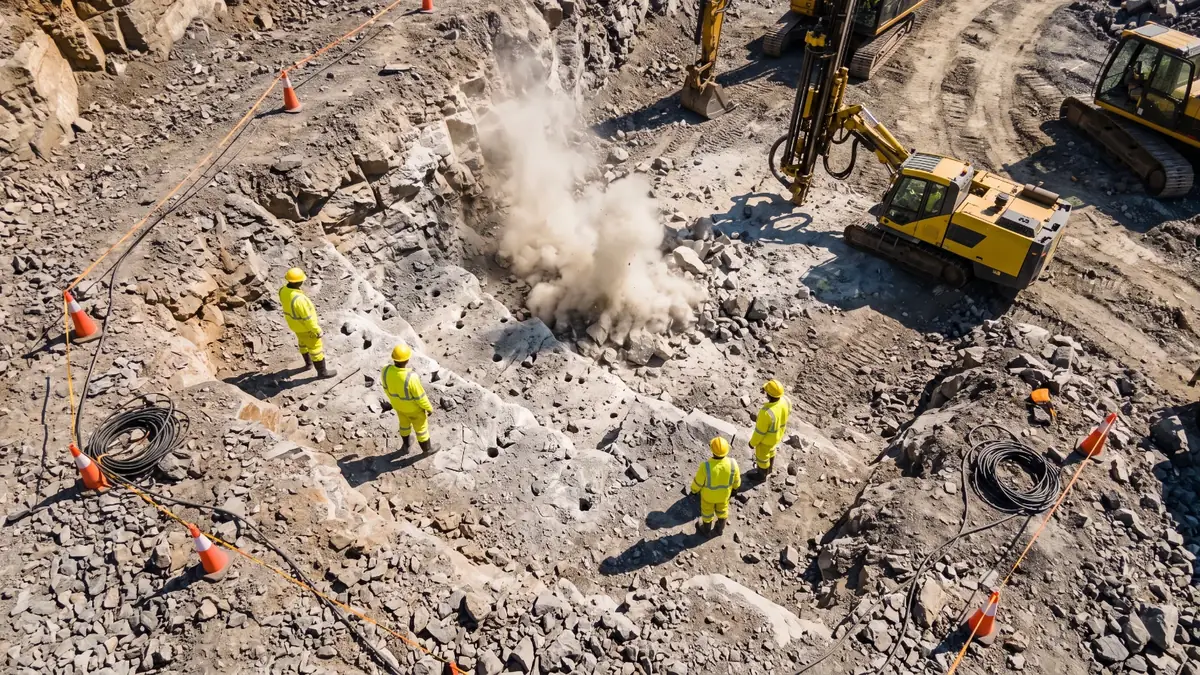
Is the quarry operating?
Quarry Blasting South Africa helps you find the best quote, fast. It is production drilling and blasting on a working face, designed so the broken rock suits the crusher behind it and the face stays safe to work. The measure is cost per tonne through the plant rather than cost per blast. Say the bench height and the tonnage you need, and get quotations to compare.
Super easy & fast
- Know what a tonne of crusher feed should cost to blast, so you never pay too much.
- Send the same bench and tonnage to several contractors, and quotes come back fast.
- From LEADERR APPROVED providers, vetted and backed by many verified 5-star reviews. Peace of mind that the crew understands a face has to be worked again tomorrow.
Quarry Blasting Prices
Ballpark figures so you can check a quotation.
| Item | Ballpark price |
|---|---|
| Drill and blast, per tonne of crusher feed | R28 - R75 |
| Drill and blast, per cubic metre in situ | R75 - R200 |
| Production drilling, per metre drilled | R95 - R260 |
| Secondary breaking of oversize, per cubic metre | R150 - R450 |
| Face profiling and survey, per blast | R6,000 - R20,000 |
| Contract blaster, per day where you own the rig | R6,500 - R18,000 |
| Mobilisation of production rig | R25,000 - R90,000 |
| Typical 20,000 tonne production blast | R560,000 - R1.5m |
Prices JUST UPDATED. Ballpark figures, rounded, excluding VAT. They reflect typical South African rock blasting, breaking and excavation rates. They are not our prices or quotations, and no provider is bound by them. Rock work is quoted on MEASURED VOLUME, and how much rock there is can only be estimated until the face is opened, so confirm what each quotation includes, such as mobilisation, whether the rate is on volume in the ground or loose, and who removes the broken rock.
Say the bench height and the tonnage you need, and get quarry blasting quotes.
Get the Best QuoteClient Reviews
Powered by leaderr
What a Quarry Rate Is Built On
- Tonnage, not blasts. Production work is priced through the plant, so the unit is the tonne.
- Bench height. A higher bench spreads the collar and the sub drill over more rock.
- Hole diameter. Larger holes move more rock per metre drilled where the bench supports them.
- Powder factor. Set by the rock and by what the crusher will accept, not by habit.
- Continuity. A standing arrangement prices better than a blast at a time.
Fragmentation Decides Your Plant Costs
- Oversize jams the primary. Every boulder over the jaw opening is handled twice and stops the plant.
- Fines are a loss. Over blasting makes material that may not sell and still cost money to make.
- The muckpile shape matters. A loose well formed pile loads faster than a tight toe bound one.
- Toe left behind is expensive. Unbroken rock at floor level means a rough floor and a second operation.
- Measure it. Photographic sizing after each blast tells you whether the design is working.
Keeping the Face Safe and Workable
- Pre split or trim the final wall. A controlled row along the limit leaves a sound wall behind.
- Stand off the crest. Drilling too close to the edge gives backbreak and an unsafe crest.
- Survey the face before drilling. Face profiling finds the real burden so a hole does not break through.
- Scale after every blast. Loose material on the face comes down before anyone works under it.
- Record everything. Designs, charge sheets and seismograph traces are the regulatory record.
Get a rate against your own tonnage rather than a range.
Get the Best QuoteWhat Affects the Price
- Tonnage a month. Volume is the single biggest lever on a production rate.
- Bench height and face condition. A clean high face is the cheapest rock to drill and blast.
- Rock hardness and abrasiveness. Both drilling and explosive consumption rise with them.
- Required product size. A crusher with a small opening needs finer rock and more explosive.
- Distance from the contractor. Production rigs are heavy and mobilisation is a real number.
- Whether you own the rig. A contract blaster on your plant is priced differently from a full service.
- Neighbours and vibration limits. A quarry near housing cannot always fire its ideal blast.
What to Include in Your Request
- The quarry location. Nearest town, and whether the site is operating or being opened.
- Monthly tonnage. What the plant needs, which is what the blasting has to feed.
- Bench height and face length. The geometry the design has to work with.
- The rock type. And any geotechnical or drill and blast records you already hold.
- The crusher opening. It sets the maximum acceptable fragment size.
- Whether you have a rig and a blaster. Full service or contract blasting only.
Questions That Change the Number
- Is the rate per tonne or per cubic metre? Both are used and they convert only if the density is agreed.
- Who carries the oversize? A cheap blast that makes boulders moves the cost to your plant.
- Is face profiling included? It prevents the blowouts and the toe that cost the most to fix.
- What is the minimum monthly tonnage? Production contracts usually carry one.
- Who keeps the statutory records? Blast designs and charge records have to be kept and produced.
- Is final wall control priced separately? Pre splitting the limit row is extra and it is usually worth it.
Quarry Blasting FAQs
What does quarry blasting cost per tonne?
Roughly R28 to R75 a tonne of crusher feed for drill and blast, depending on the rock, the bench height and the monthly tonnage. Hard abrasive rock on a short bench sits at the top of that, soft rock on a high bench at the bottom.
Should I price by the tonne or by the cubic metre?
Per tonne is the more useful figure because it matches what the plant produces and sells. Per cubic metre is what the blasting contractor measures. They convert through the in situ density, so agree that figure in the contract rather than afterwards.
What causes oversize?
Usually too wide a spacing, too little explosive for the rock, or a face with more burden than the design assumed. Face profiling before drilling catches the last of those, which is the one that produces the worst boulders and the occasional blowout.
Do I need my own blasting certificate holder?
Somebody on site must hold one and be in charge of each blast. Many quarries use a contract blaster rather than employing one, especially where blasting is a few days a month. On a mine or quarry the Mine Health and Safety Act applies.
How close to houses can a quarry blast?
It depends on the vibration limit that applies to the operation and on what the nearest structures are. Where housing has grown toward an older quarry, the usual answer is smaller blasts fired more often, with monitoring on the nearest homes and a published blasting time.
Can blasting improve my crushing costs?
Often substantially. Spending slightly more on explosive to get finer, more consistent feed usually pays for itself several times over in crusher throughput, wear and power. It is worth measuring the fragmentation rather than assuming the cheapest blast is the cheapest tonne.
Cost per tonne through the plant is the number that matters, and comparing contractors on Rock Blasting on that basis rather than on the blast price is what separates them.