
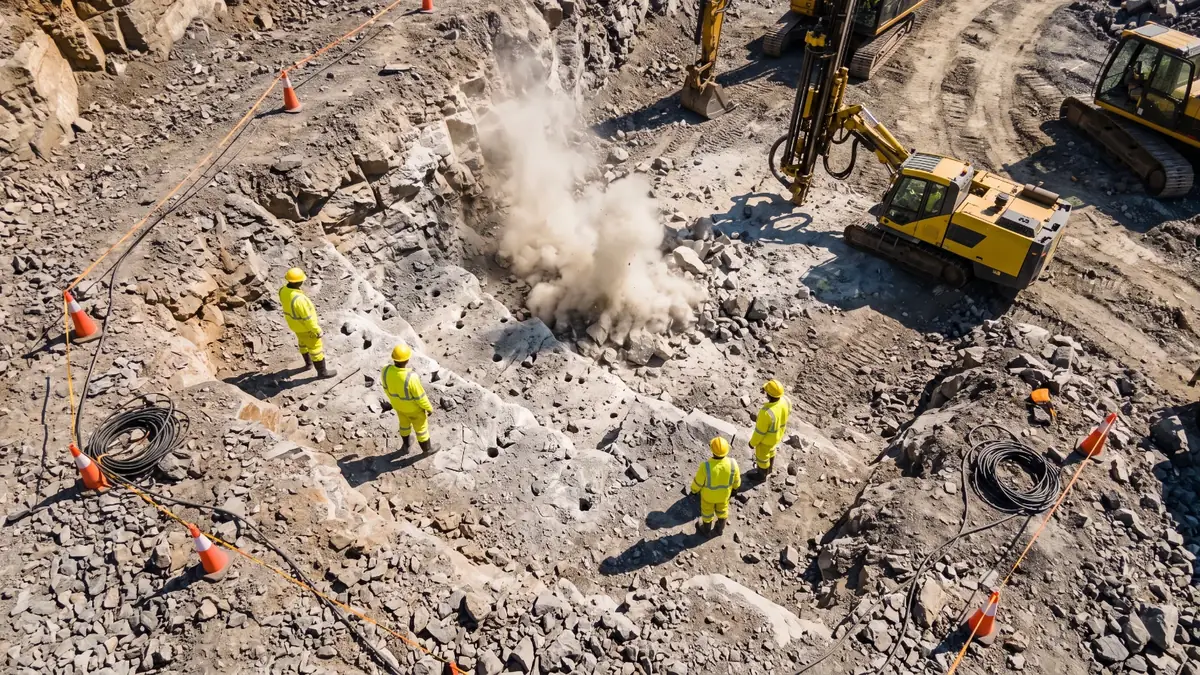
Do you have a rig already?
Drilling and Blasting South Africa helps you find the best quote, fast. It is the whole operation bought from one contractor: the pattern designed, the holes drilled, the charge loaded and the blast fired, with the face left safe to work. Buying it as one package removes the gap between the drilling and the blasting where most problems live. Say the volume and get quotations.
Super easy & fast
- Know what drill and blast should cost as one rate, so you never pay too much.
- Send one scope to several contractors, and comparable quotes come back fast.
- From LEADERR APPROVED providers, vetted and backed by many verified 5-star reviews. Peace of mind that one contractor owns the result rather than half of it.
Drilling and Blasting Prices
Ballpark figures so you can check a quotation.
| Item | Ballpark price |
|---|---|
| Drill and blast, per cubic metre, open site | R180 - R420 |
| Drill and blast, per cubic metre, constrained site | R450 - R1,100 |
| Drilling only, per metre, 64 to 89mm holes | R120 - R320 |
| Blasting only, per cubic metre, holes provided | R90 - R240 |
| Blast design and drill pattern layout | R8,000 - R35,000 |
| Mobilisation, rig and compressor, within a metro | R8,000 - R25,000 |
| Standing time, rig and crew, per hour | R900 - R2,400 |
| Typical 1,000 cubic metre platform cut | R220,000 - R520,000 |
Prices JUST UPDATED. Ballpark figures, rounded, excluding VAT. They reflect typical South African rock blasting, breaking and excavation rates. They are not our prices or quotations, and no provider is bound by them. Rock work is quoted on MEASURED VOLUME, and how much rock there is can only be estimated until the face is opened, so confirm what each quotation includes, such as mobilisation, whether the rate is on volume in the ground or loose, and who removes the broken rock.
Say the volume and the site constraints, and get drill and blast quotes.
Get the Best QuoteClient Reviews
Powered by leaderr
What the Package Includes
- The design. Burden, spacing, depth, sub drill and the delay sequence for your rock and limits.
- Setting out. Marking every collar position so the pattern on the ground matches the design.
- Drilling. To design depth and angle, with deviation controlled rather than hoped for.
- Charging and firing. Product, detonators and a certificated blaster in charge of the blast.
- Making the face safe. Scaling loose material and confirming no misfires before work resumes.
Why One Contract Beats Two
- No argument about hole quality. When the same contractor charges the holes, the drilling is to the depth it should be.
- The design follows the drilling. Deviation and lost holes are adjusted for rather than disputed.
- One measurement. Cubic metres broken, not metres drilled plus kilograms loaded.
- One programme. The rig and the charging crew are sequenced by one person.
- One accountability for the result. Fragmentation and toe belong to somebody rather than to the gap between two firms.
Where You Might Split It
- You already own a rig. Buy contract blasting only and keep the drilling in house.
- Specialist drilling is needed. Large diameter or angled holes may need a rig your blaster does not run.
- Long programmes. On multi year work, separate contracts can be re tendered independently.
- Remote sites. Mobilising a local driller and a travelling blaster is sometimes cheaper.
- Mixed methods. Part blasted and part mechanically broken often means two specialists anyway.
Get a package rate for your own job rather than a range.
Get the Best QuoteWhat Affects the Price
- Volume of rock. The rate per cubic metre falls as the quantity rises.
- Rock hardness. It drives both the drilling rate and the explosive consumption.
- Hole diameter and depth. Bigger and deeper holes move more rock per metre drilled.
- Site constraints. Neighbours, services and working hours all cut productivity.
- Access for the rig. A face a rig cannot reach changes the method and the price.
- Mobilisation distance. A fixed cost that matters most on a small volume.
- Programme certainty. A rig that can work continuously prices better than one on standby.
What to Include in Your Request
- The address. Suburb and town, so a contractor knows whether they work there.
- The volume. Cubic metres in situ, or the dimensions of the cut.
- What the rock is. Any borehole logs, geotechnical report or nearby outcrop information.
- Site constraints. Nearest structures, services, working hours and access.
- What the broken rock is for. Spoil, fill or crusher feed sets the fragmentation.
- Your programme. Start date and how long the work has to run.
Before You Appoint a Contractor
- Is the rate per cubic metre broken? A package should be measured on rock out, not on metres drilled.
- Who designs the blast? A named person with the competence to sign the design, not just the crew.
- What is the standing time rate? Rigs wait for sites more often than sites wait for rigs.
- How is lost or collapsed hole handled? Re drilling in bad ground happens and somebody pays for it.
- Is a pre-blast survey included? If there is anything within range, it should be.
- What is excluded? Cart away, oversize breaking and traffic accommodation are the usual ones.
Drilling and Blasting FAQs
What is drill and blast?
Buying the drilling and the blasting from one contractor as a single package, measured on cubic metres of rock broken. It is the normal way rock removal is contracted because it stops the drilling and the blasting blaming each other for the result.
Is it cheaper than contracting them separately?
Usually, once the arguments are counted. A split contract looks cheaper on paper and then produces disputes about hole depth, deviation and fragmentation. Splitting it makes sense when you already own a rig or when specialist drilling is needed.
What does drilling alone cost?
Roughly R120 to R320 a metre for 64 to 89mm holes, depending on rock and depth. Charging and firing holes somebody else has drilled runs around R90 to R240 a cubic metre, and most contractors will want to inspect the holes before accepting them.
How deep are the holes?
On construction sites, most patterns run between two and eight metres deep with a small amount of sub drill below the design floor so the rock breaks to level. Bench heights in quarries are higher, which is part of why quarry rates per cubic metre are lower.
What is sub drill?
Drilling a short distance below the level you want the floor at, so the rock breaks cleanly to that level instead of leaving an unbroken toe. Too little leaves a rough floor; too much wastes explosive and shakes the ground below for nothing.
Who is responsible if a hole deviates?
In a drill and blast package, the contractor, because they drilled it and they charged it. That single fact is most of the reason the package exists, and it is worth checking that your contract says so in those terms.
Package rates are the easiest to compare like for like, so sending one scope to contractors on Rock Blasting gives you quotations that line up properly.